
Technical Diagrams
Pictures for where to strike the ball, how it flies, and how to build a skill.
Top 3
- 1.Watch from the feet up to the head
- 2.Body posture and the position of readiness come before ball contact
- 3.Where the foot meets the ball decides where the ball goes
Figure 2 — Key Body Parts
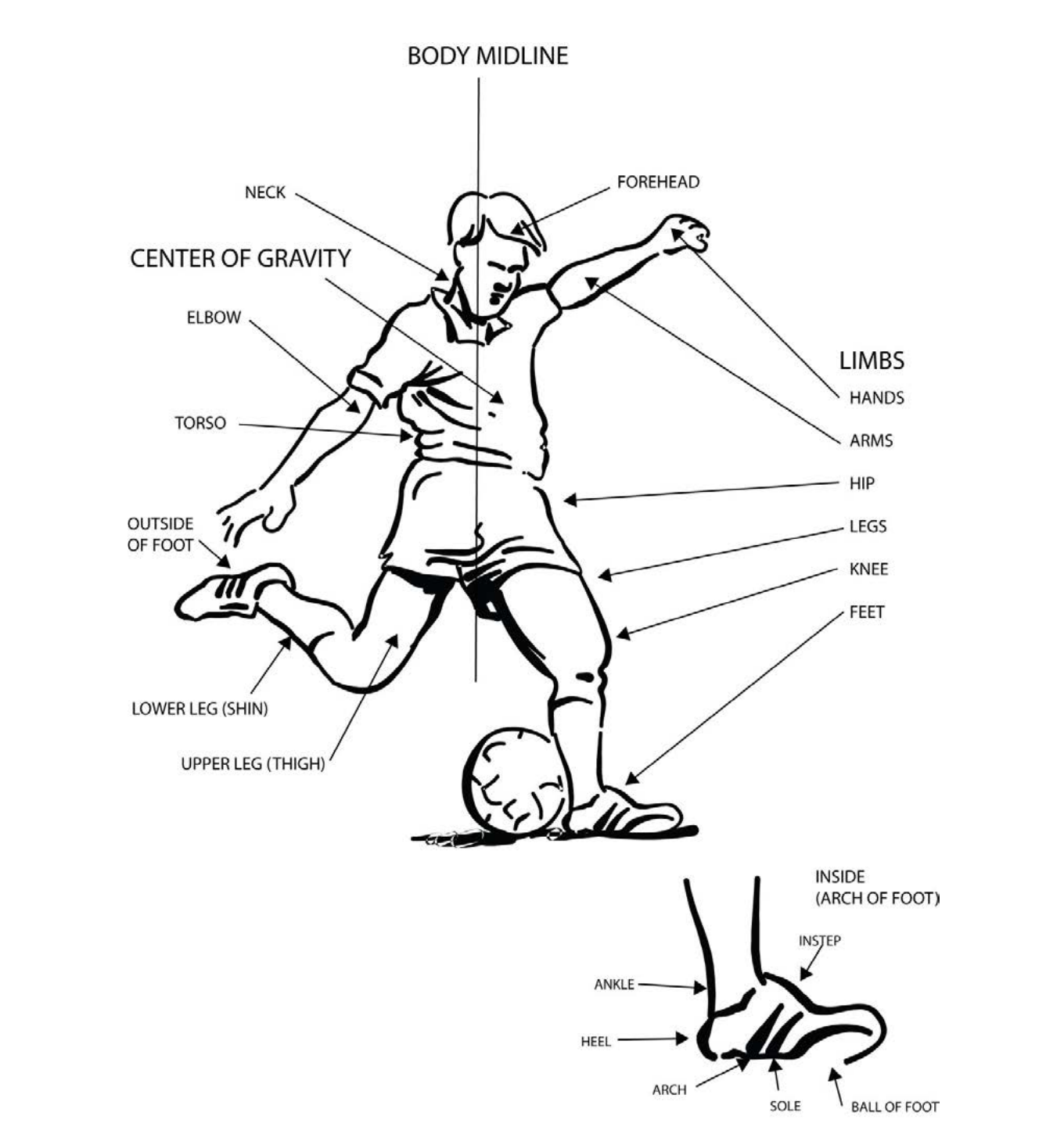
In general when analyzing a player's technique start with observing the feet and work up to the head. Correct body mechanics increase the likelihood of proper ball contact. Body posture plays a large role in skillful control of the ball.
The “position of readiness” cannot be overemphasized in its importance to executing ball skills. The “position of readiness” is the preparation phase mentioned previously. The body posture and alignment with the ball are crucially important and often overlooked by coaches and players alike.
Figure 6 — Ball Action
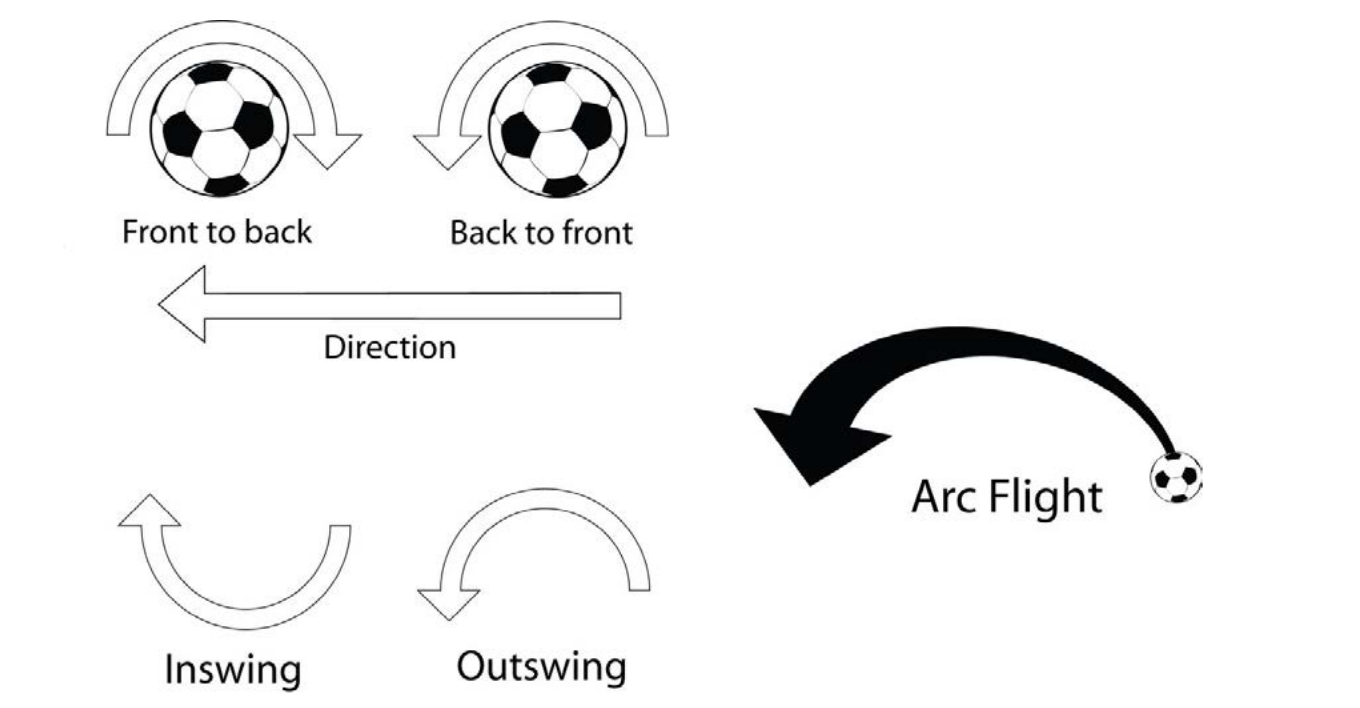
With swerve the teaching progression is flat flight, arc flight, out-swing, in-swing and dip.
Figure 7 — Ball Axis
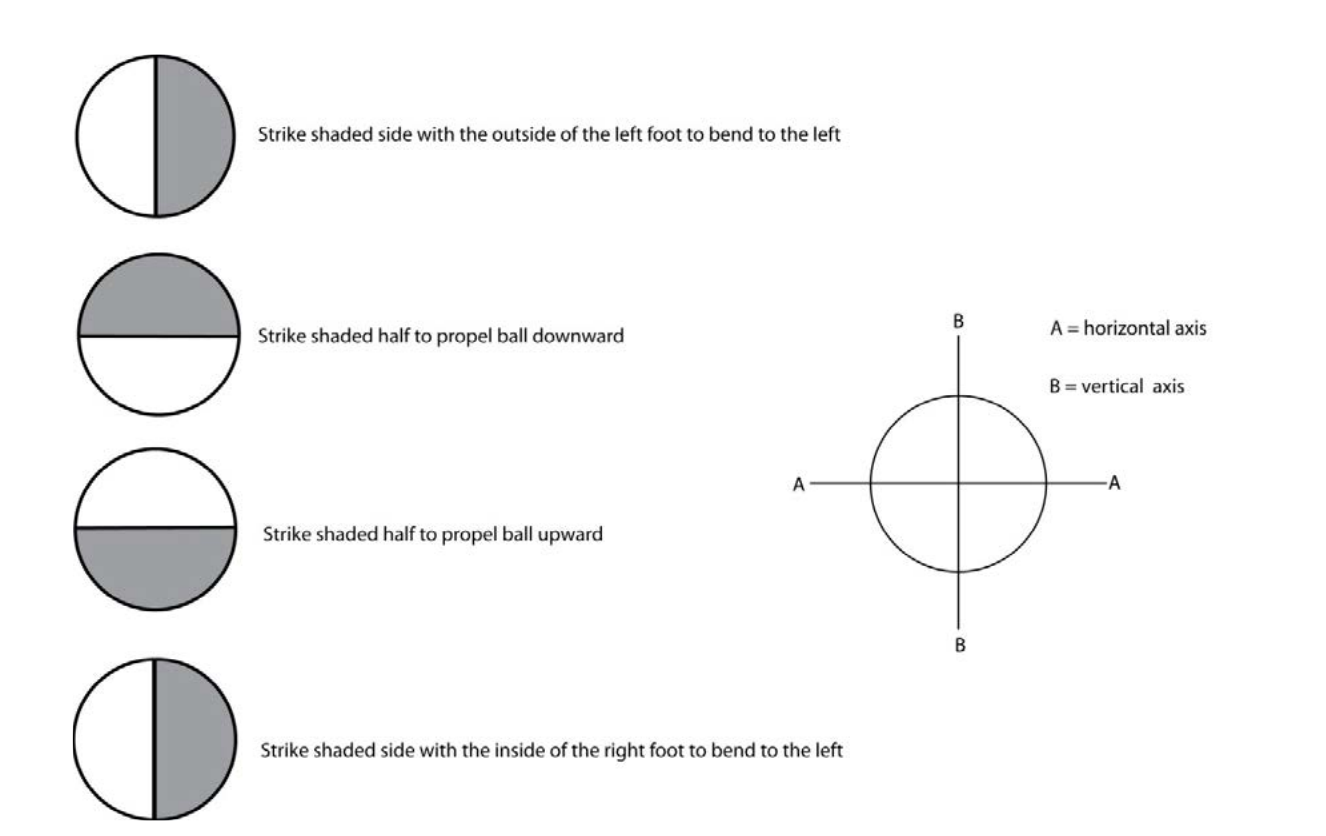
Understanding which part of the ball to contact is crucial to the execution of many techniques. In figure 7 the ball has been divided by two lines A and B. They are the axis lines of a sphere. When the ball is struck above line A then it will be propelled downward, which could be important in a side volley shot on goal as an illustration. When the ball is struck below line A then it will rise and this is important for a lofted pass for instance. When the ball is struck to either side of line B then the ball will swerve, which is important in bending passes for example.
The better a coach understands the properties of the ball, its sections and aspects of its movement, then the coach will be able to read the movement of the ball as the player propels or receives it. By reading the ball action the coach can then guide the player toward improved technique.
A ball will travel in a straight line only if it has been kicked exactly at its center point and exactly in the correct direction. Direction (accuracy) and height of the ball when passing or shooting become quite important factors as players mature within the game.
- Strike shaded side with the outside of the left foot to bend to the left
- Strike shaded half to propel ball downward
- Strike shaded half to propel ball upward
- Strike shaded side with the inside of the right foot to bend to the left
Factors that determine the height of the ball
- The position of the support leg
- The position of the kicking foot
- The movement of the upper torso
- Whether the ball is hit above or below the center point (intersection of lines A & B)
Progression for gaining a feel for the ball
Even within game-like activities there can be a progression for gaining a feel for the ball. While such a progression is not always necessary it may be useful when presenting a new ball skill in this format:
- i. The ball and the player are stationary while the ball is propelled to a stationary target
- ii. The ball and player are stationary while propelling the ball to a moving target
- iii. The player is dribbling or moving while propelling the ball to a stationary target
- iv. The player is dribbling or moving while propelling the ball to a moving target
Tracking the ball
A ball rolling on the ground has an immediate backdrop to it. This backdrop makes it easier to judge the pace and spin of the ball. A bouncing ball infrequently has an immediate backdrop; at the moment it touches the ground. A ball in the air has no backdrop.
Prior to age 9 visual tracking acuity is not fully developed. Players have difficulty accurately tracking long kicks or the ball off of the ground. Beginning at approximately age 10 the visual tracking acuity achieves an adult pattern.
One Club • One Philosophy • One Language